
Glasses Measurements Can Help You Find a Frame Size That Fits
Knowing your glasses measurements can be useful when it’s time to get a new pair. If you have some old, well-loved frames, then their measurements are often a great starting point for your browsing. But measurements aren’t the only factor that matters, and they shouldn’t completely dictate your style decisions. They’re helpful guidelines when searching for the frames your heart desires.

Have you ever looked at one of the arms of your glasses and thought, What do those numbers mean? Or, perhaps you didn’t realize that glasses had numbers displayed on them in the first place?
The numbers inscribed on the inside of the arm are eyeglass measurements. They’re one way to find a glasses size that feels comfortable on your face and does a good job of correcting your vision. Differences of just a few millimeters can significantly change how glasses look and feel on your face, so they can be an important part of getting to know your eyewear.
Want to know your glasses size? We’ll teach you how to read and take these measurements, as well as how to pick out some perfectly sized frames.
What Do the Numbers On Glasses Mean?
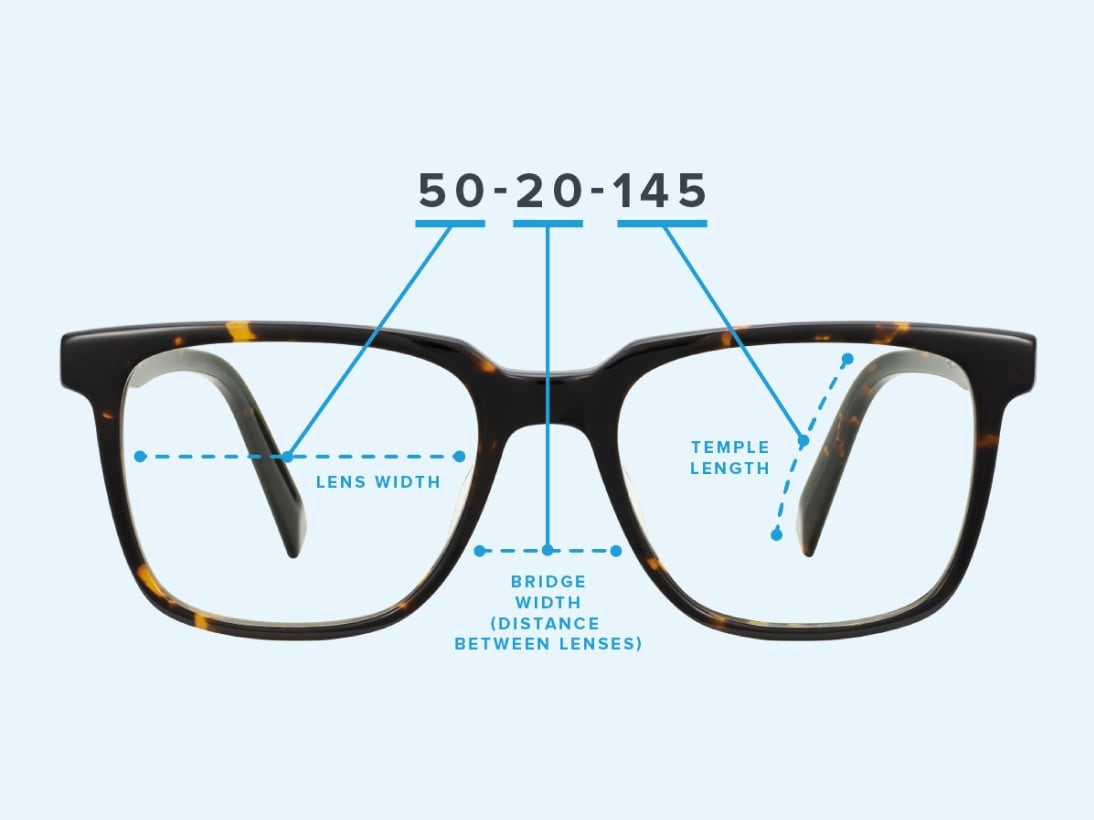
You’ll find up to three numbers on glasses frames, and they stand for the lens width, bridge width, and temple length. These numbers are written on the inside of one arm and may be separated by spaces or dashes. Often, a small square shape separates the lens width from the bridge width.
You may see other letters or numbers on the arm, and these could refer to the frame model, color, brand, or manufacturer. Usually, the glasses measurements are easy to spot, as they follow the same order and have standard ranges, all expressed in millimeters. Here’s how to read them.
Lens Width
Lens width, also known as “eye size,” is always the first glasses measurement in the series. It tells you the width of each lens in millimeters. This measurement only accounts for the width of the clear lens that you look through, meaning it doesn’t include any of the surrounding frame.
Typical range: 40–60 mm
Bridge Width
The bridge width measures the shortest span between the two lenses in your frames. (Counterintuitively, it’s not just a measurement of the part of your glasses frame called the bridge.) Smaller bridge widths accommodate narrower noses, whereas glasses with larger bridge widths are best for wider noses.
Typical range: 14–24 mm
Temple Length
The temple length measures each temple (or arm) of your glasses, starting from the screw where it attaches to the main body of the frame all the way to the tip that goes behind your ear. This measurement often ends in a zero or a five, with 135, 140, 145, and 150 being common standards.
Wearing the right temple length for your face ensures the temple arms of your frame are long enough to extend behind your ears—without protruding too far past them.
Typical range: 120–150 mm
Other Glasses Dimensions
The above three measurements are the most important when you’re learning how to read glasses sizes. Opticians and glasses designers deal with a whole slew of other glasses measurements, too, but laypeople don’t often encounter them.
There are two more measurements you might want to know as you search for a pair of glasses. These usually aren’t displayed on the frame, but they can still factor into fit and performance.
Frame Width
The frame width is the overall width of the entire frame, measured at its widest point (usually from endpiece to endpiece). Rather than looking for an exact frame width number when shopping for new glasses, many people operate by this simple rule: Your glasses frames shouldn’t be much wider than your face, and your eyes should be centered within the lenses.
Typical range: 125–150 mm
Lens Height
Lens height is the vertical height of the lens from its lowest to highest point. It’s an especially relevant measurement when you’re getting multifocal or progressive lenses, which need a certain amount of space for their different visual zones.
Typical range: 32–38 mm
How to Measure Glasses on Your Own
Curious about your glasses measurements? If they’re not listed on the arm of your frame, or you just want to confirm them, you can always take them yourself. Grab a soft measuring tape or ruler that displays millimeters and examine each part.
How to measure lens width: Measure horizontally across one lens at its widest point. Do not include any part of the frames.
How to measure bridge width: Measure the distance between your two lenses and see how many millimeters are between their nearest points.
How to measure temple length: This one is a two-parter! Measure the temple from the hinge on the main body of the frame to the point where it starts to curve. Then measure from the curve to the very tip of the temple arm. Add these two numbers together.
How to measure frame width: Measure across the front of your glasses frames horizontally at the frames’ widest point. Be sure to include any decorative bits that protrude from the sides so you’re getting the widest accurate measurement possible.
How to measure lens height: Measure across the front of your lenses vertically at their tallest point. (Tip: For any kind of multifocal lens, the lens height should be at least 30 millimeters.)
How to Measure Your Face for Glasses
Not everyone who needs new glasses has an old pair that they can reference for measurements. In these cases, it can be helpful to look at your face (and your face shape) and make some estimations as to what glasses size you might need. But remember: Comfort, fit, and confidence are your top priorities, and the best way to find the right frame for you is by trying glasses on!
Get to Know Your Nose Bridge
You want glasses that will sit effortlessly on your nose without sliding up or down. Look at the bridge of your nose in the mirror and note how close your eyes are to it.
If your nose is relatively narrow, you’ll want a narrower bridge. The opposite is true if your nose is wider. You can also take stock of where exactly the bridge of your nose is on your face: If it’s high up, you might look for glasses with a higher bridge, near the brow line. If it’s lower, you might be a great candidate for Low Bridge Fit frames.
Measure Your Pupillary Distance
Your pupillary distance is pretty much what it sounds like—the distance between your pupils. It’s a helpful measurement for optometrists and opticians who are preparing your lenses. The goal is to have your pupils centered behind each lens for the best vision correction possible.
You can measure your pupillary distance at home and use it when buying glasses online or in-store. Although your pupillary distance shouldn’t impact the size of your glasses, it will affect the placement of the “optical center” of the lens (i.e., the part you’ll be looking through).
Hold a Credit Card Up to Your Face (Yes, Really)
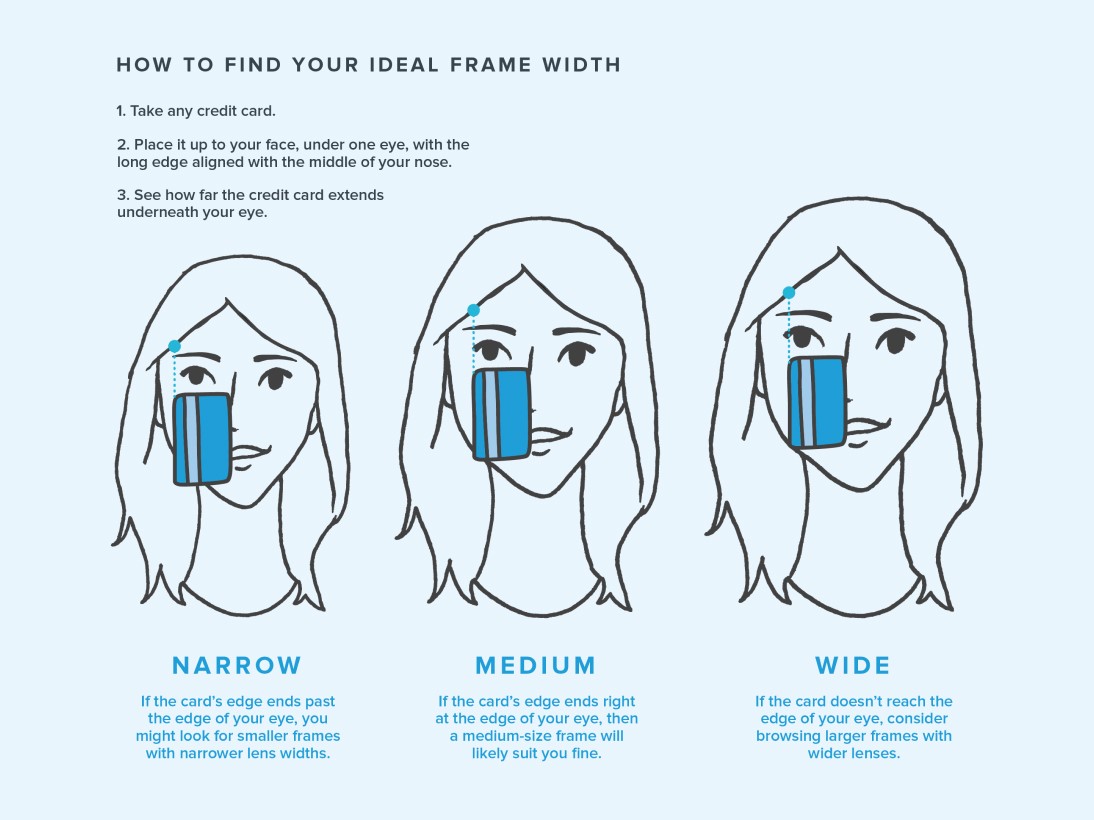
A standard-size credit card has a short edge that’s about 54 millimeters long. By positioning this edge underneath your eye, you can get a rough idea of what size glasses and lenses you might need.
Simply hold the credit card up to your face, under one eye, with the long edge aligned with the middle of your nose. See how far the credit card extends underneath your eye.
- If the card’s edge ends past the edge of your eye, you might look for smaller frames with narrower lens widths.
- If the card’s edge ends right at the edge of your eye, then a medium-size frame will likely suit you fine.
- If the card doesn’t reach the edge of your eye, consider browsing larger frames with wider lenses.
Glasses Size Chart
Consult the chart below to see how glasses measurements can correspond to different frame sizes.

